
Sr. Joe Biden’s China Experience – Defense; Taiwan; Trade; US Debt; Human Rights; Tibet
|
US Treasury Secretary Henry Paulson: “One of the first challenges the next US president will face will be how to respond to China’s emergence as a global power…I believe that engagement is the only path to success.” Let’s examine Sr. Joseph Biden’s experience and records on China issues in chronological order:
--------------------------------------------- BBC NEWS: Tuesday, 7 August, 2001, 14:49 GMT 15:49 UK US senator offers help to China
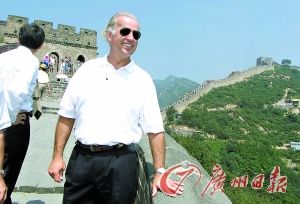
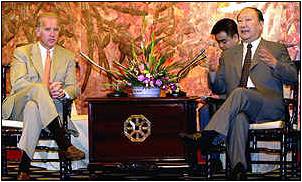
The most senior United States senator dealing with international relations, Joseph Biden, is in China for talks likely to include US plans for a new missile defense shield, Chinese arms sales and China's human rights record. Senator Biden, chairman of the Senate's Foreign Relations Committee, is due to meet senior government leaders at a seaside retreat on Wednesday, including President Jiang Zemin. In Shanghai on Tuesday, he said he wanted to help China understand the US policy on the sensitive issue of Taiwan. But he warned the Chinese Government that it must do its part to prevent President Bush's controversial missile defense system from becoming a reality. Senator Biden's visit to China comes at a key moment, with Chinese leaders bitterly opposed to the Bush administration's missile defense plans. Senator Biden's visit to China comes at a key moment, with Chinese leaders bitterly opposed to the Bush administration's missile defense plans. |


|
(Chinationreport: Mr. Chen Shui-bian has since been replaced by Mr. Ma Ying-Jeou who is a Harvard Law School alumnus to Senator Obama. Mr. Chen is currently under criminal investigation due to alleged severe corruption and money laundering. ) They say it could be used to defend Taiwan if China ever decided to use force against the island, and as such could spark an arms race in Asia. Senator Biden, whose Democratic party recently won control of the senate, has also warned Mr Bush that introducing such a system without addressing the concerns of China and Russia could have a destabilizing effect. In Shanghai he kept up the pressure on President Bush not to break off unilaterally the Anti-Ballistic Missile Treaty, a necessary first step for building such a system. Mr Biden said he did not believe President Bush would do this but he said if he did he was unlikely to win the support of the Senate. |
|
|
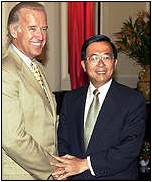
However, he also put pressure on Beijing, calling on President Jiang Zemin to urge neighboring North Korea not to develop new intercontinental missiles - Senator Biden warned that if North Korea did so, it would increase support in the Senate for a missile defense program. Taiwan clarification He stressed the US did not see China as a hostile country and he said he hoped China's leaders would understand the US was only committed to selling weapons to Taiwan for defensive purposes, and did not support Taiwan independence. He did, however, stress his admiration for Taiwan's President Chen Shui-bian, who is seen by Beijing as a key supporter of independence. Another member of his delegation, Republican Senator Fred Thompson, highlighted another strand of US political opinion, accusing China of breaking its commitments not to transfer missile technology to Pakistan. He said the US congress had to decide whether it should continue to engage in trade with a country which he said was making the world a more dangerous place. ---------------------------------------------- Source: BBC: Wednesday, 8 August, 2001, 17:34 GMT 18:34 UK Senator rejects China missile promise
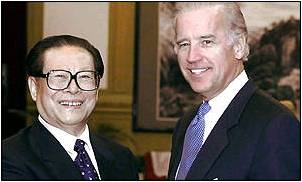
Influential US Senator Joseph Biden said after talks with Chinese President Jiang Zemin that they had "agreed to disagree" on whether China was keeping to its commitments on missile proliferation. The matter was at the top of the US delegation's agenda after fresh allegations this week in a US newspaper that China had sold missile technology to Pakistan despite promising last year not to do so. |
|
China has denied the allegations but Senator Biden said increased weapons proliferation would make a US missile defense system, which China opposes, more likely, and could endanger trade agreements. Chinese state media reported conciliatory remarks by President Jiang, highlighting "common interests" and the need for China and the US to strengthen "mutual understanding... and cooperation". But Defence Minister Chi Haotian was also quoted taking a harder line on US arms sales to Taiwan and explicitly opposing American missile defense system plans, which China fears could be used to defend Taiwan. Senator Biden is the Democratic chairman of the US Senate's Foreign Relation's Committee. He advocates engagement with China and has spoken against Republican plans to build a missile defence system unless there is wide international agreement. |
History teaches us that cooperation is beneficial for our two countries and confrontation is harmful for both
President Jiang Zemin |


|
Diplomatic relations between the US and China have been warming slowly since a low point a few months ago during a row over an incident involving a US spy plane in which a Chinese pilot died. Warm words and warnings Chinese state television quoted President Jiang after the meeting as saying: "Whether... tackling weapons proliferation, environmental degradation or international crime, China and the United States have common interests." The president said China had kept to its commitments on weapons proliferation, according to Senator Biden. "We agreed to disagree on that point," he said. Senator Biden said President Jiang was specifically opposed to North Korea and Iran gaining ballistic missile technology. Human rights Other issues raised included China's judicial system and the treatment of the banned Falun Gong spiritual movement. Senator Biden's delegation, which includes three other senators, have already visited Taiwan. They are due to travel to Beijing for two days of meetings with business leaders and officials, and on Saturday fly to Seoul to meet South Korean President Kim Dae-jung. ------------------------------- Source: pg.china-embassy.org/eng/xwdt/t47645 Chinese Foreign Minister Tang Jiaxuan Meets Biden 2001/08/10 Tang noted that China attaches importance to the visit of Biden, and welcomes more US congressmen to visit China. He said the Chinese government values Sino-U.S. relations and China and the U.S. have shared common interests although differences still exist. He also noted that China hopes to expand contact and dialogue with the United States, to promote mutual understanding and trust, and to seek the converging points of bilateral interests so as to improve Sino-U.S. relations Expressing thanks to the Chinese side for its warm reception, Biden said that Sino-U.S. relations are at a critical time, and it is important for both sides to strengthen trust and avoid misunderstanding. Biden said he came to China to exchange views with the Chinese side and to promote mutual understanding. He noted that great changes have taken place in China over the past 20 years, and China's international influence has expanded, adding that the development and prosperity of China conforms to the US interests. -------------------------------------- Source : Transcript: Sens. Biden, Levin on ‘FNS’ Monday, January 22, 2007
WALLACE: And, finally, Senator Biden, China, which showed this week that it has the capacity to launch missiles and take out satellites in space — how provocative an action? And what do we need to do about it? BIDEN: I think it is provocative. I think we have many options to deal with it. We accomplished that goal 25 years ago. It was a kinetic kill, as they call it. It did not use lasers. There are ways to blunt that. But one of the things we have to talk about is whether or not the, sort of, ideological base notion about how we deal with space and weapons in space and the use of weapons from space is something that is a path we should continue to follow. This is basically — this administration's policy has been the Rumsfeld proposal prior to him coming in as secretary, and it radically changed our view of how we're going to use space. I think it's worth us beginning to consider it, but I don't think we should be overly worried about this at this point. We have ways to deal with that ability that they've demonstrated they possess that will put us in a position where we still have clear eyes in space. But the other side of that is, though, this is not the direction we want to go, in escalating competition in space. And we should be talking about it. --------------------------------------- Source: 2007 AFL-CIO Democratic primary forum Aug 8, 2007 Q: Is China an ally or adversary? Joe Biden: China holds the mortgage on our house, to pay for war They're neither. The fact of the matter is, though, they hold the mortgage on our house. This administration, in order to fund a war that shouldn't be being fought and tax cuts that weren't needed for the wealthy--we're now in debt almost a trillion dollars to China. We better end that war, cut those taxes, reduce the deficit and make sure that they no longer own the mortgage on our home. Barack Obama: China is a competitor, but not an enemy China is a competitor, but they aren’t an enemy, as long as we understand that they are going to be negotiating aggressively for their advantage, and we've got to make sure that we're looking after American workers. That means enforcing our trade agreements; it means that if they're manipulating their currency, that we take them to the mat on the that issue; it means that we are also not running up deficits and asking China to bail us out. --------------------------------------- Source: August 15th 2007 "There ain't no such thing as free trade unless it's fair trade,'' the Delaware senator said. He also warned that the U.S. is too dependent on Chinese credit. "We have to get off sucking that breast that is China,'' Biden said. ---------------------------------------- SOURCE: 2008CENTRAL.NET 2:46: Question - Would you restrict trade with China? Biden would not restrict trade through tariffs. He justifies this by saying that we are over emphasizing the significance of China. 3:07: What kind of human rights commitment should the U.S. try to get from China? Biden says hold China accountable at the United Nations. ------------------------------------------ Source: cameron.blogs.foxnews.com/category/candidates/joe-biden-candidates Biden:” We’re making them 10 feet tall. A country with 800 million in poverty does not have greater leverage over us ..Preposterous.” Biden said. ” What we’ve done is yield leverage (to big corporations)….As president, Bang, no importing of those (Chinese)toys.” -------------------------------------------- Source: Expressindia.com/latest-news/Terror-obsessed-Bush-ignored-rise-of-India--China--says-Biden/336431 Terror-obsessed Bush ignored rice of India, China, says Biden Washington, July 16: Slamming the Bush administration for “ignoring” major global developments that included the rise of India and China, a prominent US lawmaker has said that it was pursuing a policy that seemed “obsessed with the war on terrorism”. “... by exploiting the politics of fear, instigating an optional war in Iraq before finishing a necessary war in Afghanistan and instituting policies on torture, detainees and domestic surveillance that fly in the face of our values and interests, President (George W) Bush divided Americans from each other and from the world,” Senator Joseph Biden said in Washington in a campaign speech on “Renewing American Leadership”. “At the heart of this failure is an obsession with the ‘war on terrorism’ that ignores larger forces shaping the world and the lives of Americans in this new century: The emergence of China, India, Russia and a united Europe; The spread of lethal weapons and dangerous diseases; Uncertain supplies of energy, food and water;... A rapidly warming planet; The challenge to freedom from radical fundamentalism.” Instead of focusing on these forces, Biden, the Democratic Chairman of the Senate Foreign Relations Committee charged that Bush “has fixated on a small number of radical groups that hate America, turning them into a ten-foot tall existential monster that dictates every move we make." ----------------------------------------------- SOURCE: ALLAMERICANPATRIOTS.COM/48745496_SENATORS-INTRODUCE-RESOLUTION-CONDEMN-VIOLENCE-TIB SENATORS TO INTROUDUCE A RESOLUTION TO CONDEMN VIOLENCE IN TIBET The resolution is cosponsored by Senators Joseph Biden (D-Del.), Amy Klobuchar (D-Minn.), Sherrod Brown (D-Ohio), Elizabeth Dole (R-N.C.), Maria Cantwell (D-Wash.), Olympia Snowe (R-Maine), Robert Menendez (D-N.J.), Susan Collins (R-Maine), Barack Obama (D-Ill.), Senator Robert Byrd (D-W.V.), Senator George Voinovich (R-Ohio), and Charles Schumer (D-N.Y.). “It is critical that the Chinese government and the Dalai Lama engage in a mutually respectful dialogue to restore peace and stability in Tibet,” said Senator Biden. “By engaging in talks with Tibet instead of violence, President Hu would gain the opportunity to speak the motto of the Beijing Olympics – ‘One World, One Dream’ – to the entire international community. I can think of no greater symbol of peace than to have President Hu Jin-tao and the Dalai Lama jointly attend the opening ceremony of the games, united in their commitment to promote genuine reconciliation on the Tibetan plateau.” Specifically, the resolution: * Condemns the violence in Tibet and calls for restraint by the Government of the People’s Republic of China and the people of Tibet; * Calls for a dialogue between the leadership of the Government of China and His Holiness the Dalai Lama on meaningful religious and cultural autonomy for Tibet within China and urges that these discussions take place with all deliberate speed; * Calls for the release of individuals who protested in a peaceful manner and for medical care for those injured and wounded in the violence that followed the protests; * Calls on the Government of China to cease its efforts to enter monasteries to “reeducate” monks and nuns, to respect the right of the people of Tibet to speak of the Dalai Lama and possess his photograph, and to respect and protect basic human rights, as provided in the Constitution of the People’s Republic of China; * Calls on the Government of China to honor its commitment to allow international journalists free access to China from mid-2007 to October 17, 2008; * Calls on the Government of China to provide a full accounting of the March 2008 protests in Tibet, the response of the Government of China, and the manner and number of detentions and deaths that occurred following the protests; * Calls on the United States Department of State to fully implement the Tibetan Policy Act of 2002 (22 USC 6901 note), including the stipulation that the Secretary of State “seek to establish an office in Lhasa, Tibet to monitor political, economic, and cultural developments in Tibet”, and also to provide consular protection and citizen services in emergencies; and * Urges that the agreement to permit China to open further diplomatic missions in the United States should be contingent upon the establishment of a United States Government office in Lhasa, Tibet
|
